Saturday, November 21, 2009

Gold's 'Money' Value is $4,000 to $11,000: Market Strategist

By: JeeYeon Park

Federal Reserve officials on Thursday downplayed the consequences of the falling U.S. dollar, pointing to deflation as a lingering threat. The dollar has fallen 7 percent so far this year and likely has become a funding vehicle for bets on higher-yielding currencies in growing emerging markets. So how should investors guard their portfolios? Jim Rickards, senior managing director of market intelligence at Omnis, shared his insights.

“[The Fed is saying] we’re nowhere near the all-time lows, we’re back to where we were 15 to 18 months ago…So they look at that and say we’ve been there before,” Rickards told CNBC.

“My only view is that it’s a much more unstable and dangerous world: In the '80s, our creditors were Japan, Europe and the [Arab states]—and the three of them were utterly dependent on the U.S. for their national security.”

China is now the U.S.' main creditor and they don’t depend on America for national security, said Rickards. So the U.S. "doesn’t have a lever" to keep China "in line" economically or force Beijing to buy Treasury securities.

Rickards cautioned investors to stay out of the currency trade, as Fed Chairman Ben Bernanke is selling the U.S. dollar and China is selling its yuan. Instead, he advised investors to buy gold.

“Gold is not moving on a monetary vector, it’s moving on supply/demand fundamentals,” he said.

“Very few people think of gold as money. If you think of gold as money, that level is a range between $4,000 and $11,000 an ounce—that’s the price gold will have to be to support the money supply.”

Gold's 'Money' Value is $4,000 to $11,000: Market Strategist

Reblog this post [with Zemanta]

Friday, November 20, 2009

Foreclosures: Prime Borrowers Are The Latest Victims

Sign Of The Times - Foreclosure

Image by respres via Flickr

Alan Zibel

The foreclosure crisis likely will persist well into next year as high unemployment pushes more people out of homes, pulls down housing prices and raises concerns about the broader economic recovery.

The latest evidence was a report Thursday that a rising proportion of fixed-rate home loans made to people with good credit are sinking into foreclosure. That's a shift from last year, when riskier subprime loans drove the housing crisis.

The report from the Mortgage Bankers Association also found that 14 percent of homeowners with a mortgage were either behind on payments or in foreclosure at the end of September. It was a record-high figure for the ninth straight quarter.

The data suggest the housing market and the broader recovery will remain under pressure from the surge in home-loan defaults, especially as unemployment keeps rising. Lost jobs are the main reason homeowners are falling behind on their mortgages.

Foreclosures: Prime Borrowers Are The Latest Victims

Reblog this post [with Zemanta]

Audit The Fed Effort Wins Support From An Unusual Coalition

Ron Paul at the Free State Project's Liberty F...

Image via Wikipedia

Arthur Delaney

An unusual coalition of progressive economists, labor leaders, and bloggers has decided to fight back against a congressional amendment that would allow the Federal Reserve to continue operating in secrecy.

In a Thursday letter to the House Financial Services Committee, economists like Dean Baker and Rob Johnson, author Naomi Klein, and such labor luminaries as the AFL-CIO's Richard Trumka and the SEIU's Andy Stern, urged committee members to shoot down an amendment by Rep. Mel Watt (D-N.C.) that would essentially allow the Fed to keep the lights off while it throws money around.

Watt's amendment, which could see a House vote today, is a direct attack against a separate measure by Reps. Ron Paul (R-Texas) and Alan Grayson (D-Fla.). That measure, known as the "Audit the Fed" bill, has been gaining momentum in Congress for months.

"A vote for the Watt amendment is a vote for more secret bailouts," the letter says.

Audit The Fed Effort Wins Support From An Unusual Coalition

Reblog this post [with Zemanta]

Thursday, November 19, 2009

Garnter Identifies Top 10 Mobile Apps for 2012

Gartner, Inc. has identified the top 10 consumer mobile applications for 2012. Gartner listed applications based on their impact on consumers and industry players, considering revenue, loyalty, business model, consumer value and estimated market penetration.

“Consumer mobile applications and services are no longer the prerogative of mobile carriers,” said Sandy Shen, research director at Gartner. “The increasing consumer interest in smartphones, the participation of Internet players in the mobile space, and the emergence of application stores and cross-industry services are reducing the dominance of mobile carriers. Each player will influence how the application is delivered and experienced by consumers, who ultimately vote with their attention and spending power.”

“The ultimate competition between industry players is for control of the ‘ecosystem’ and user experience, and the owner of the ecosystem will benefit the most in terms of revenue and user loyalty,” Ms. Shen said. “We predict that most users will use no more than five mobile applications at a time and most future opportunities will come from niche market ‘killer applications’.”

The top 10 consumer mobile applications in 2012 will include:

Garnter Identifies Top 10 Mobile Apps for 2012

Reblog this post [with Zemanta]

Strauss-Kahn Sees Yuan Role in Special Drawing Rights

Dominique Strauss-Kahn, Managing Director, Int...

Image via Wikipedia

Bloomberg

Dominique Strauss-Kahn, the managing director of the International Monetary Fund, said that the yuan may in future be added to the basket of currencies that set the value of IMF monetary units called special drawing rights.

The yuan, also known as the renminbi, could be added in a “while,” Strauss-Kahn said at a press briefing in Beijing today. The move would require the currency to be market-based, he said.

Today’s comments highlight the widening role for the currency of the world’s fastest-growing major economy at a time when officials from countries including China and Russia have challenged the dollar’s dominant position. While China is arranging for more cross-border trade to be settled in yuan, the currency is limited by not being freely convertible.

“The stability of the international financial system can’t hinge on the currency of one single country, even though that’s the largest economy in the world,” said Hua Ercheng, chief economist in Beijing at China Construction Bank Corp. and a former economist with the Washington-based IMF. “The currency basket of SDRs needs to be more representative to diversify risks.”

Strauss-Kahn Sees Yuan Role in Special Drawing Rights

Reblog this post [with Zemanta]

Michael Panzner: Commercial Real Estate Is A "Tsunami Unfolding"

Lawrence Delevingne

Michael Panzner is bearish, and you should listen.

Why?

The 25-year veteran of the global stock, bond, and currency markets was one of the few who called the crisis before it happened, with a book aptly titled "Financial Armageddon."

Today, Panzner calls a V-shaped recovery "ridiculous," says commercial real estate is a bubble sure to burst, and is fearful that there's far too much speculation on commodities, risky stocks and emerging markets. In short, he says "the world is a riskier place and will continue to stay that way going forward."

Michael Panzner: Commercial Real Estate Is A "Tsunami Unfolding"

Subprime home mortgages back to pre-crisis levels: Fed

Federal Home Loan Mortgage Corporation (Freddi...

Image via Wikipedia

The market share of subprime US home mortgages, which caused the collapse of the housing market at the epicenter of the financial crisis, has returned to pre-crisis levels, a central bank report showed Monday.

But the Federal Reserve Bank of San Francisco study said nearly all of the loans were now owned or guaranteed by the government, which has pumped hundreds of billions of dollars to keep the market afloat.

Government-backed agencies Fannie Mae, Freddie Mac and Ginnie Mae "are providing unprecedented support to the housing market -- owning or guaranteeing almost 95 percent of the new residential mortgage lending," said John Krainer, a senior economist with the regional central bank who penned the report.

"This shift in mortgage finance has had a profound impact on the types of borrowers receiving loans," he said.

The subprime market had shrunk to virtually zero percent in the first quarter of 2008 after triggering the housing collapse following defaults by borrowers.

Subprime borrowers, usually lacking good credit histories, find it nearly impossible to obtain mortgage loans from mainstream lenders.

Subprime home mortgages back to pre-crisis levels: Fed

Reblog this post [with Zemanta]

Wednesday, November 18, 2009

GOLD HITS ANOTHER HIGH, ASIAN SHARES REBOUND

Gold hit another all-time high on Wednesday on worries about future inflation and economic uncertainties, while Asian stocks rebounded as the generally bearish dollar kept riskier assets in demand.

Spot gold rose as high as $1,143.95 per ounce in early Asia trade, settling later just above $1,140, with expectations for a continued weakness in the US currency also providing a support.

indian stock market tipsThe dollar rose as investors trimmed short positions after euro zone economic policymakers followed US Federal Reserve Chairman Ben Bernanke in commenting about the merits of a strong dollar, but dealers said the rebound would likely be limited.

"It's going to be hard for the dollar to gain further, since it looks like that the US will keep its low interest rate policy for a while," said Tomohiro Nishida, treasury department manager at Chuo Mitsui Trust and Banking Company in Tokyo.

GOLD HITS ANOTHER HIGH, ASIAN SHARES REBOUND

Tuesday, November 17, 2009

What the Google Voice Team Will Do with Gizmo5

Image representing Gizmo5 as depicted in Crunc...

Image via CrunchBase

Clint Boulton

Google was very cagey when asked what its Google Voice team would do with the Gizmo5 startup it acquired last week.

Gizmo5 makes Web-based calling software for mobile phones and computers. Specifically, it provides a Web-based VOIP client that lets users make phone calls over the Internet, similar to programs such as Skype.

Google's secrecy matters little, at least in Andy Abramson's mind. The VOIP consultant, who long lobbied for Google to buy Gizmo5, said Google could take the Gizmo5 assets, bolster the Google Talk Web chat client and bundle them with Google Voice, the phone management application that rings calls to home, work and cell phones through one number.

That's how Google would take on Skype, but there is potential for a broader play here.

Combine the Google Talk (with Gizmo5 endpoint support) and Google Voice applications with Google's Android mobile operating system and users have one control point for all of their Web-based calling needs.

Google will have the opportunity to offer PC-to-PC and PC-to-phone calling services, supported by Android devices with Android applications without racking up minutes on carriers' cell phone data plans. People have done this!

What the Google Voice Team Will Do with Gizmo5

Reblog this post [with Zemanta]

Bernanke's rare intervention fails to calm fears over weak dollar

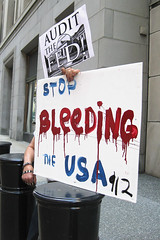
Stop Bleeding the USA

Image by r0b0r0b via Flickr

By James Quinn

In a rare moment of intervention into the currency markets from America's leading central banker, Mr Bernanke admitted the Fed is watching the dollar "closely" as part of its focus on employment growth and price stability.

Mr Bernanke stressed the dollar will remain "strong" and continue as a "source of global financial stability".

But his comments, part of a speech in New York, were not enough to stop the dollar's fall, easing 0.6pc against a basket of major currencies, allowing sterling to rise by more than a cent to $1.6830.

The Fed chairman went on to reiterate the central bank's earlier commitment to keeping US interest rates exceptionally low "for an extended period".

Barclays Capital's US economist Michelle Meyer interpreted Mr Bernanke's comments as "simply stating that the Fed will monitor the dollar…and…not suggesting that the Fed will try to target the dollar".

Bernanke's rare intervention fails to calm fears over weak dollar

Reblog this post [with Zemanta]

Apture