
Showing posts with label Finance. Show all posts
Showing posts with label Finance. Show all posts
Wednesday, October 6, 2010

Sunday, October 3, 2010
Count on Sequels to TARP

Image via Wikipedia
Gretchen Morgenson
THE government is pulling a sheet over TARP, the Troubled Asset Relief Program created during the panic of 2008 to bail out the nation’s financial institutions. With the program’s expiration on Sunday, we can expect to hear lots of claims from the folks at the Treasury that it was a great success.
Such assertions would be no surprise from a political class justifiably concerned about possible taxpayer unhappiness, the continuing economic turmoil and the midterm elections. But if we have learned anything during this crisis, it is that the proclamations emanating from the Washington spin machine must be taken with an extra-hefty grain of salt.
Consider the claims made last summer that the Dodd-Frank financial reform act reduces the threats that large, interconnected banks pose to taxpayers and the economy when the banks are deemed too big to fail. Indeed, as regulators hammer out the rules governing derivatives transactions, it’s evident that the law has created a new set of institutions that will almost certainly be deemed too important to fail if they ever get into trouble. And that means there won’t really be an effective way to keep those firms from taking big, profitable, short-term risks that are dumped on the taxpayers when the bets fail.
Our roster of bailout candidates includes the clearinghouses, created under Dodd-Frank, that are meant to increase the oversight of derivatives trading. Because most derivatives transactions are expected to go through these clearinghouses, they will be “systemically important” under the law. As such, Dodd-Frank specifically provides that “in unusual or exigent circumstances,” the Federal Reserve may provide such entities with a financial backstop, including borrowing privileges.

Friday, October 1, 2010
Governments' Bad Investments
By Iain Murray
The Wall Street Journal reports that municipalities all over the nation are teetering on the verge of bankruptcy ("Local Debts Defy Easy Solution," September 23). This may be the final proof that the ongoing financial crisis is not a crisis of free markets, as populist politicians and media have characterized it. The municipal debt crisis is a political crisis, one created by politicians making bad decisions with taxpayer money in order to funnel it to their cronies and supporters.
Why are municipalities in so bad a position? For the most part, because of deals cut with public employee unions. One of the prime benefits a labor union brings to its members is a fat pension plan that, in theory, is generously funded by the citizens of the municipality the union members work for.
For union-friendly politicians, this was a sweet deal. They could reward their labor supporters with generous benefits, while passing the buck of raising taxes to pay for those benefits on to their successors years into the future. Now those bills are coming due. As the Journal says, state and local pension plans "have promised over $3 trillion in retirement benefits," while their pensions assets "are at least $1 trillion shy of that." California's pension shortfall is larger than the GDP of Saudi Arabia, oil riches and all.

Monday, September 27, 2010
The Road To World War III: The Global Banking Cartel Has One Card Left To Play
By David DeGraw
When we analyze our current crisis, focusing on the past few years of economic activity blinds us to the history and context that are vital to understanding the root cause. What we have been experiencing is not the result of an unforeseen economic crash that appeared out of the blue with the collapse of the housing market. It was certainly not brought on by people who bought homes they couldn’t afford. To frame this crisis around a debate on economic theory misses the point entirely. To even blame it on greedy bankers, while essentially accurate, also misses the most vital point.
This crisis is the direct result of a strategic economic attack on the existence of a middle class and democracy worldwide. The stock market and economy have become weapons of mass oppressionmanipulated by an imperial banking cartel to impose order and exploit the masses. This crisis boldly represents the manifest evolution of the fascist spirit reasserting itself as the dominant ideology.
Any fairytale notions of the United States being a democratic republic built on the rule of law have been utterly dispelled. As a nation we have been bred and conditioned to be dangerously naïve to the darker forces which operate beyond the spotlight of the mainstream media. We have been blinded to what has been developing throughout the world.
The Road To World War III: The Global Banking Cartel Has One Card Left To Play

Sunday, September 26, 2010
Walking away with less
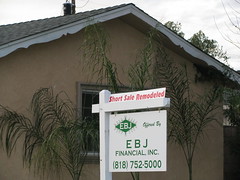
Image by TheTruthAbout... via Flickr
By Dina ElBoghdady and Dan Keating
A new wave of distressed home sales is rippling, more quietly this time, through American cities and suburbs.
Its unsettling effects are playing out here in Manassas, along Brewer Creek Place, a modest, horseshoe-shaped street lined with 98 brick townhouses. Several years after the U.S. foreclosure crisis erupted, the U-Hauls are back.The last time, banks seized nearly every fourth house on the street through foreclosure. This time, homeowners are going another route: a short sale.
"I love this house, but I just have to leave," said Leanna Harris, 27, the owner of a corner unit that used to be the builder's model, with a stone path in the yard and a gourmet kitchen. "I'm at peace with it now."
The original owner bought the home for $400,714 in 2006; Harris and her husband, both bartenders, paid what seemed to be a bargain price, $289,000, in 2008. But they have fallen behind on their mortgage payments, in part because her husband was out of work. Now they have a $246,000 offer for the home, and the balance on their mortgage is more than that. They want to accept the offer. All they need is their bank's okay.
That kind of deal is called a short sale, and it's sweeping the country. In these deals, a lender allows a troubled borrower to sell a home for less than what's owed on the mortgage.

Why QE2 + QE Lite Mean The Fed Will Purchase Almost $3 Trillion In Treasurys And Set The Stage For The Monetary Endgame

Image via Wikipedia
Tyler Durden
Recently the debate over when QE2 will occur has taken a back seat over the question of what the implications of the Fed's latest intervention in monetary policy will be, as it is now certain that Bernanke will attempt a fresh round of monetary stimulus to prevent the recent deceleration in the economy from transforming into outright deflation. Whether or not the Fed will decide to engage in QE2 on its November 3 meeting, or as others have suggested December 14, and maybe even as far out as January 25, the actual event is now a certainty. And while many have discussed this topic in big picture terms, most notably David Tepper, who on Friday stated that no matter what, stocks will benefit from QE2, few if any have actually considered what the impact of QE2 will be on the Fed's balance sheet, and how the change in composition in Fed assets will impact all marketable asset classes. We have conducted a rough analysis on how QE2 will reshape the Fed's balance sheet. We were stunned to realize that over the next 6 months the Fed may be the net buyer of nearly $3 trillion in Treasurys, an action which will likely set off a chain of events which could result in rates dropping all the way to zero, stocks surging, and gold (and other precious metals) going from current price levels to well in the 5 digit range.
Credit Unions Bailed Out

Image via Wikipedia
By MARK MAREMONT And VICTORIA MCGRANE
Two years after the peak of the financial crisis, the federal government swooped in to stabilize a crucial part of the credit-union sector battered by losses on subprime mortgages.
Regulators announced Friday a rescue and revamping of the nation's wholesale credit union system, underpinned by a federal guarantee valued at $30 billion or more. Wholesale credit unions don't deal with the general public but provide essential back-office services to thousands of other credit unions across the U.S. The majority of retail credit unions are sound, but they will have to shoulder the losses through special assessments over the next decade.
Friday's moves include the seizure of three wholesale credit unions, plus an unusual plan by government officials to manage $50 billion of troubled assets inherited from failed institutions. To help fund the rescue, the National Credit Union Administration plans to issue $30 billion to $35 billion in government-guaranteed bonds, backed by the shaky mortgage-related assets.
Officials said the plan won't cost taxpayers any money. Still, it marks the latest intervention by the U.S. government into a financial system weakened by the real-estate bust. Bad bets on mortgage-backed securities have now killed five of the nation's 27 wholesale credit unions since March 2009. The federal government, which now controls about 70% of the total assets at such credit unions, said the surviving institutions will be reined in so that they take fewer risks with their investments.
Credit Unions Bailed Out
Wednesday, September 22, 2010
That Rumbling Sound Is the Dollar Giving Way

Image via Wikipedia
For nearly twenty years, we haven’t flinched from our prediction that the massive debt build-up of the last generation would precipitate out as a deflationary bust. That is what we still expect, although we now believe there is likely to be a hyperinflationary phase at some point as the financial system implodes. But the bottom line is that no matter how things play out, America’s standard of living will fall more steeply than at any other time since the Great Depression. As for the deflation-vs.-hyperinflation “debate,” it is useful only to the extent it helps predict how mortgage debtors will fare as this economic cataclysm plays out. We seriously doubt they will be “saved” by the kind of hyperinflation that would put hundred-thousand-dollar bills in Joe Homeowner’s wallet. Imagine how mortgage lenders would react if Joe could peel off three or four of those bills and say, “Okay, pal, we’re square.” This scenario will seem particularly unlikely to those who believe that these economic hard times have been engineered by Masters of the Universe intent on stealing our property. Trust us on this: If there’s a hyperinflation, it is the rentiers who will get screwed most ruinously, not the little guys.
That Rumbling Sound Is the Dollar Giving Way

Gold hits another record as it nears $1,300

Image via Wikipedia
Global equities and government bond prices rose after the Fed on Tuesday laid the groundwork for further stimulus measures and expressed concerns about low inflation, yet made no policy shift at the end of a one-day meeting.
Spot gold hit a new record of $1,294.95 an ounce, before easing to $1,293.10 an ounce by 9.45am (GM, still showing a 0.6pc gain on the day. US gold futures rose by $21 an ounce to $1,294.50, having hit a contract high at $1,296.5.
"The key driver was the ... [Fed's] statement and the subtle change in language that it was 'prepared to provide additional accommodation if needed', a shift from the previous wording that it "will employ its tools as necessary'," said Robin Bhar, a Credit Agricole analyst.
"We interpret this as a conditional easing bias. It pushes the door for QE2 [another round of quantitative easing] wider and the implication that this has for a weaker dollar and further unease of what governments will do to weaken their currencies to support flagging economic growth."
Should the Fed resort to a second round of quantitative easing, which involves large-scale purchases of US government bonds to keep interest rates low in exchange for a cash injection into the system, gold's appeal to investors grows as the opportunity cost of holding a non-yield-bearing asset declines.
Also, fresh cash in the economy raises the risk of a pickup in inflation, which erodes the returns from currency, equity and bonds holdings, yet benefits owners of gold, who see the value of their holdings rise in line with consumer prices.
Gold hits another record as it nears $1,300
Monday, September 20, 2010
Bill Buckler Discusses The Last Price Standing Of "True Money", Answers The Only Question Relevant To Gold Bugs

Image via Wikipedia
Tyler Durden
Bill Buckler, publisher of The Privateer Report, has released one of the most scathing critiques of paper money we have read to date: "Before it can be exchanged, wealth must be created. Wealth cannot be created out of thin air. By definition, an economic good is “scarce”. If it were not, there would be no such thing as economics or exchange. Neither would be necessary because no effort or choice in the face of alternatives would be required in order to provide the GOODS which further our lives. Before we can talk about money and the VITAL role it performs, we must stress this point. Money is NOT wealth, it is the means by which wealth is exchanged amongst those who produce it. Paper money is not suited to this function." So what is the only rational investment in times in which money's role is so often confused by pretty much everyone? "Ninety-seven percent of all existing Treasury debt has been created since August 15, 1971! Ninety-three percent of it has been created since Mr Volcker “saved” the paper Dollar in late 1979! Please note that the gain in Treasuries and the loss in the US Dollar almost exactly cancel out. Please note also that even the biggest gain in these paper markets fades into insignificance against Gold’s rise."And here is the answer all the "gold bugs" have been waiting for: "The paper money “price” of Gold will last as long as the attempt to make paper money “work” lasts. In the end, Gold will no longer have a “price” because it has reverted to its role as MONEY. Whenever and wherever that happens, that nation can return to the production of wealth - rather than “money”."

Sunday, September 19, 2010
Defaults Account for Most of Pared Down Debt

Image via Wikipedia
By Mark Whitehouse
0.08% — The annual rate at which U.S. consumers have pared down their debts since mid-2008, not counting defaults.
U.S. consumers might not be quite as virtuous as they seem.
The sharp decline in U.S. household debt over the past couple years has conjured up images of people across the country tightening their belts in order to pay down their mortgages and credit-card balances. A closer look, though, suggests a different picture: Some are defaulting, while the rest aren’t making much of a dent in their debts at all.
First, consider household debt. Over the two years ending June 2010, the total value of home-mortgage debt and consumer credit outstanding has fallen by about $610 billion, to $12.6 trillion, according to the Federal Reserve. That’s an annualized decline of about 2.3%, which is pretty impressive given the fact that such debts grew at an annualized rate in excess of 10% over the previous decade.
There are two ways, though, that the debts can decline: People can pay off existing loans, or they can renege on the loans, forcing the lender to charge them off. As it happens, the latter accounted for almost all the decline. Over the two years ending June 2010, banks and other lenders charged off a total of about $588 billion in mortgage and consumer loans, according to data from the Fed and the Federal Deposit Insurance Corp .
.
That means consumers managed to shave off only $22 billion in debt through the kind of belt-tightening we typically envision. In other words, in the absence of defaults, they would have achieved an annualized decline of only 0.08%.
Defaults Account for Most of Pared Down Debt

Saturday, September 18, 2010
Americans' Net Worth Tanked In Second Quarter, Erasing This Year's Gains

Image by bransorem via Flickr
Americans' net worth plunged in the second quarter of this year, new data from the Federal Reserve show, erasing the gains of the previous two quarters and adding evidence to the argument that the economy has entered a double-dip recession.
The net worth of households and non-profit organizations dropped $1.52 trillion during the period from April 1 to June 30 of this year, according to the report released Friday. The new figure, $53.50 trillion, represents a 2.8 percent decline from the previous quarter.
The net quarterly loss, the data suggests, came from Americans' losses in the sagging stock market. Equity shares owned by households and non-profits tanked in the second quarter, dropping $1.88 trillion or 11.2 percent to $14.87 trillion from the previous quarter. The second quarter figure went down past the territory of 2009's third quarter ($15.32 trillion), almost to the range of the 2009 second quarter ($13.06 trillion), when equity was just starting to rise from its low of $10.94 trillion in the first quarter of that year.
The Dow rose 4.1 percent in the first quarter of this year and fell 10.0 percent in the second quarter.
Total household wealth showed a 5.9 percent increase over the same period last year, which isn't saying much, since at that point the economy was only just beginning to improve. More significantly, Americans' net worth has approached levels not seen since the third quarter of 2009, when the total was $53.03 trillion, and when it was steadily increasing.
Americans' Net Worth Tanked In Second Quarter, Erasing This Year's Gains

U.S. Retirement Deficit Reaches $6.6 Trillion: 'God Help the Poor Gen Xers'

Image via Wikipedia
America's retirement crisis has reached epic proportions, according to a recent study by Boston College's Center for Retirement Research. The study estimates that the current retirement income deficit, or the gap between the retirement savings of U.S. households and what they need to have in order to maintain their living standards past retirement, is a whopping $6.6 trillion -- five times the projected federal deficit for 2010.
"The key sources of income retirees are relying on are either under attack, in the case of Social Security, or disappearing, in the case of traditional pensions," said Ross Eisenbrey, vice president of the Economic Policy Institute, at a press conference on Wednesday. "The early Boomers are better off than the late Boomers, and God help the poor Gen Xers. Seventy percent of them are on a track that leads to a fallen standard of living in retirement."
According to the latest retirement income data, half of 65-and-older households have an annual income of less than $29,744 -- about half the median income of younger households. Traditional pensions are disappearing in favor of 401(k) plans, which allow employers to shift much of the cost and all of the risk to their employees, and on top of this, Congress is considering cutting Social Security to balance the federal budget.
Maria Freese, director of government relations for the National Committee to Preserve Social Security and Medicare, said that the $6.6 trillion estimated retirement deficit is a "conservative number" and that the crisis could become far worse if Social Security is compromised.
U.S. Retirement Deficit Reaches $6.6 Trillion: 'God Help the Poor Gen Xers'

Friday, September 17, 2010
Household Net Worth Plunges By Most Since Q4 2008, As Government Borrowing Surges

Image by Getty Images via @daylife
Tyler Durden
Arguably the most useful report to come out each quarter out of the Federal Reserve is the Z.1, or the Flow of Funds report, which was released minutes ago. And it's a doozy: household net worth (assets less liabilities) in Q2 2010 plunged by $1.5 trillion, almost exclusively due to a plunge in Corporate Equities ($0.9 trillion) and Pension Fund holdings ($0.7 trillion). In other words, the net wealth of the US household continues to track the performance of the stock market tick for tick. And one wonders why the Fed, per Alan Greenspan's admission, is only focused on ramping stocks up to all time highs. Total household financial assets declined by $1.7 trillion to $43.7 trillion, which was the biggest swing factor, as the tangible assets, or housing, was kept flat at $23.7 trillion. Incidentally, to assume that Real Estate value increased in Q2 from $18.7 trillion to $18.8 trillion in Q2, is one of the dumbest things to ever come out of the Fed: we expect that this number will plunge soon after it is realized that the double dip in housing is here, forcing another major contraction in household net worth. On the other side of the balance sheet, liabilities were also flat at $13.9 trillion sequentially. And possibly the most important data point: the change in borrowings, confirmed that everyone is deleveraging except for the government... whose borrowing surged at a 24.4% SAAR, the second highest ever, after the 28.9% surge in Q2 2009. In other words, Keynesianism is alive an well in the US, and any talk of austerity in the US is nothing less than not that funny stand up comedy.
Household Net Worth Plunges By Most Since Q4 2008, As Government Borrowing Surges

China’s War Uses U.S. Debt Against U.S. Dollar

Image via Wikipedia
By Byron King
Recently, the U.S. Treasury Department released data showing an 11% decline in official Chinese holdings of U.S. government bonds during the past year.
The Chinese government isn’t adding to its U.S. bond position. Nor is it rolling over its previous purchases. Instead, between September 2009–June 2010, Chinese holdings of U.S. bonds fell from $938.1 billion to $843.7. That’s a drop of over $94 billion over nine months.
The Chinese are backing away from U.S. debt. They’re reducing their exposure to the U.S. dollar, and by extension their vulnerability to a declining U.S. economy.
What’s going on? Is the decline in Chinese holdings of U.S. bonds strictly an economic assessment? Or is there something else afoot? What factions are driving this decision? And what does all of this mean for precious metals?
China’s War Uses U.S. Debt Against U.S. Dollar

Home Prices Could Drop For The Next Three Years: Report

Image by Getty Images via @daylife
Thinking about buying a home? You might want to proceed cautiously. The housing market may continue to decline, potentially for at least three more years, Bloomberg reports today.
There is some evidence that a double-dip in housing may be looming. According to data released by CoreLogic today home prices remained flat in July compared to the same period last year, the first time in five months without a year-over-year increase. Compared to June of this year, prices in July declined 0.6 percent.
But the housing market's biggest concern is an excess of housing inventory, which continues to grow as mortgage-holders default and more homes hit the anemic market Bloomberg estimates that 12 million homes will flood the market over the next three years, as lenders put the "shadow inventory," or homes with delinquent loans, up for sale.
Citing analysis from Moody's, Fannie Mae, Barclays and Morgan Stanley, Bloomberg reports the housing market has already tanked 28 percent since 2006. It's been a fairly dismal summer for housing, as July saw a 25.5 percent drop in existing sales from the same period in 2009, according to the National Association of Realtors. It was the lowest number of existing home sales since 1995.
As long as prices continue to fall, the conventional wisdom goes, sales won't rebound, as potential buyers wait on the sidelines. Making matters worse, a whiff of recovery could send prices right back down. A survey by online real estate search company Zillow shows that 3.8 million homes, or five percent of the nation's total, would hit the market within six months of any housing market improvement, as their owners try to take advantage of higher prices.
Home Prices Could Drop For The Next Three Years: Report

Thursday, September 16, 2010
Foreclosures Rise; Repossessions Set Record

Image by Getty Images via @daylife
By: Joseph Pisani
US foreclosure activity rose in August from the previous month, and banks and lenders took ownership from homeowners at a record pace, according to a new report released Thursday.
Bank repossessions, often the final step in the foreclosure process after a home fails to sell at auction, increased about 2 percent from the month before to 95,364, a record high. At the same the number of properties that received default notices—the first step in the foreclosure process—decreased 1 percent from a month ago and fell 30 percent from a year ago, a sign that lenders are focusing on their backlog of foreclosure inventory before tackling new distressed loans, according to foreclosure listing website RealtyTrac, which released the report.
Overall, foreclosure fillings rose 4.18 percent in August from the previous month, and were down 5.48 percent from a year ago. In all, 338,836 properties were in the foreclosure process. One in 381 U.S. households received a foreclosure notice in August. (Foreclosure notices are defined as a default notice, auction sale notice or bank repossession.)
“There is a buildup in delinquent loans that are not in foreclosure,” said Rick Sharga, senior vice president of RealtyTrac, adding that banks and lenders are slowing the process to avoid a drop in home prices. “It’s a managed slowdown more than anything else,” he said.
“The underlining conditions haven’t improved,” Sharga added, referring to high unemployment and falling home prices in certain markets.
Foreclosures Rise; Repossessions Set Record

Monday, September 13, 2010
Central Banks Leading New Gold Rush

Image via Wikipedia
Bob Lenzner
No wonder gold rose to $1,260 an ounce this week before easing. One by one, central banks are amassing major gold positions, proof positive that they want to participate in the world's most glamorous asset class. Think central banks taking investment advice from global hedge funds.
This is probably a unique order in the investment jungle. The major seller, the International Monetary Fund, does not look too sharp. It sold 541,700 ounces of the shiny metal in July alone according to Uncommon Wisdom, an investment service I've been monitoring.
So far in 2010 Russia has increased its gold holdings by 2.8 million ounces, $3.6 billion at current prices. Total holdings by the Putin government total almost $30 billion. Saudi Arabia and the Philippines have disclosed new gold buying in 2010, plus India, Sri Lanka and Mauritius bought gold in 2009.
The World Gold Council seems sure the People's Bank of China also is a major accumulator of gold. It makes sense that some portion of China's $2 trillion in reserves would be held in gold. It is a hedge against global economic uncertainty. For others, it is a substitute for paper money. More recently, it's been a hot investment.
Central Banks Leading New Gold Rush

Trading Eludes Dodd-Frank as Investors See Black Box

Image via CrunchBase
By Bradley Keoun
It took a Congressional inquiry this year to force Goldman Sachs Group Inc. to disclose how much it made in the mortgage market -- and that was only for 2007.
Goldman Sachs hasn’t revealed mortgage-trading revenue since then, leaving investors to guess how much it contributes to thefixed-income, currency and commodities division, or FICC, which also trades junk bonds, yen, oil and uranium, sells weather derivatives and operates power plants. The division brought in $23.3 billion last year, or 52 percent of the New York-based firm’s total, and by itself would rank 90th by revenue in the Standard & Poor’s 500 Index, just ahead of McDonald’s Corp., according to data compiled by Bloomberg.
The Dodd-Frank Act, designed to prevent future financial crises, does little to improve investors’ ability to analyze results at the five biggest U.S. firms that trade securities, which together lost $38.6 billion as markets froze in the fourth quarter of 2008. Since taxpayers may have to bail out banks again, firms should be forced to disclose more, said Tanya Azarchs, former head of North American bank research at Standard & Poor’s.
“The health of the banking system impinges on all areas of the economy,” said Azarchs, now a consultant in Briarcliff Manor, New York. “So their disclosure has to be top-notch.”
Trading Eludes Dodd-Frank as Investors See Black Box
UK set for double-dip recession, warns BDO

Image via Wikipedia
By Kara Gammell
The research by BDO, the accountants and business advisers, said long-term economic prospects are not showing signs of improvement.
BDO's Optimism Index – which reflects how UK businesses expect trading to develop in the medium term – tumbling to 93.1 in August from 95.5 in July.
These levels have not been seen since the deepest parts of the recession, between November 2008 and July 2009. It is also the first time the index has dropped below the crucial 95 mark since July 2009, suggesting that the economy may contract at the end of this year.
The company's output Index, which tracks UK businesses' turnover expectations, also shows a marked drop from 99.8 in July to 97.8. This data points to sluggish economic growth in the second half of the year.
The lack of confidence may coincide with government communications around forthcoming fiscal tightening, combined with the looming Comprehensive Spending Review that will set out the government's spending plans from 2011 to 2015.
Peter Hemington, partner at the firm, said: "If the end of 2010 does indeed turn out to be the st
UK set for double-dip recession, warns BDO

Subscribe to:
Posts (Atom)