Friday, December 4, 2009

America Without a Middle Class

Wall Street

Image by jpellgen via Flickr

Elizabeth Warren

Can you imagine an America without a strong middle class? If you can, would it still be America as we know it?

Today, one in five Americans is unemployed, underemployed or just plain out of work. One in nine families can't make the minimum payment on their credit cards. One in eight mortgages is in default or foreclosure. One in eight Americans is on food stamps. More than 120,000 families are filing for bankruptcy every month. The economic crisis has wiped more than $5 trillion from pensions and savings, has left family balance sheets upside down, and threatens to put ten million homeowners out on the street.

Families have survived the ups and downs of economic booms and busts for a long time, but the fall-behind during the busts has gotten worse while the surge-ahead during the booms has stalled out. In the boom of the 1960s, for example, median family income jumped by 33% (adjusted for inflation). But the boom of the 2000s resulted in an almost-imperceptible 1.6% increase for the typical family. While Wall Street executives and others who owned lots of stock celebrated how good the recovery was for them, middle class families were left empty-handed.

Elizabeth Warren: America Without a Middle Class

Reblog this post [with Zemanta]

The Recurring Gold 'Bubble'

Tim Lacono

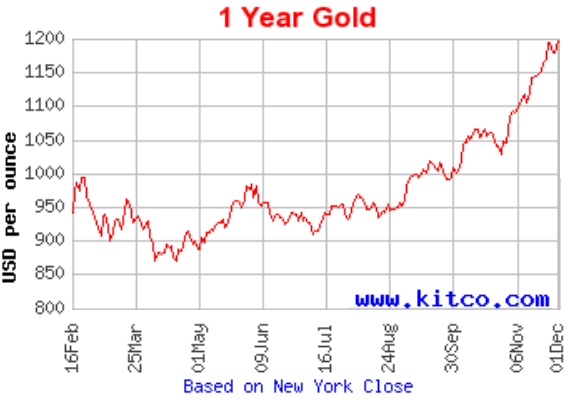
A lot of people are getting all worked up about the rising price of gold. Some say the current move has gone "parabolic" and that we're in the midst of a "blow-off top" akin to the early 1980s peak that saw the gold price disappoint investors for years afterward.
Just this morning, Hu Xiaolian, a vice-governor at the People's Bank of China, called gold a bubble and implied that the central bank wasn't much interested in buying thousands more tonnes of bullion as bank reserves at current prices.
Looking at the one-year gold chart below it's hard to disagree with that view, but there's much more to the story than that. In fact, as compared to previous moves up in this decade, the recent move has been rather tame so far for reasons that will be explained in a minute.
IMAGE

Since the yellow metal began its decade-long ascent in 2000, there have been distinct periods of rising prices, most of which have begun in the odd numbered years

The Recurring Gold 'Bubble' -- Seeking Alpha

Reblog this post [with Zemanta]

Thursday, December 3, 2009

The Dubai File: Is Venezuela Headed for a Default?

Chávez calls for the surrender of all forces o...

Image via Wikipedia

by rc whalen

"The market flutter caused by the unilateral debt moratorium by Dubai suggests to us is that the illusion of stability created by the Federal Reserve Board over the past year is starting to dissipate.  Specifically, there are many Dubai type situations in the global markets, both sovereigns and corporates, that are over-extended and are unable to service their debts at par.  The corporates will end up in restructuring but the sovereigns are an open question."  
"We would not be surprised to see more sovereign debtors make unilateral announcement of debt moratoriums and/or restructurings, perhaps including even oil rich Venezuela.  We notice in that regard that Venezuela’s lider maximo, Hugo Chavez, is preparing to nationalize the few remaining private banks of that nation, usually a good indicator of an approaching sovereign default."
I have been following VE, both as a journalist and professionally, for many years.  While Chavez does have a reasonably tight grip on the security situation, c/o his Cuban trained praetorian guard, the economy is a mess, even with plentiful oil.  Indeed, not only has Chavez managed to wreck the state oil company so that VE barely meets half of its OPEC production quota, but inflation is running wild.

The Dubai File: Is Venezuela Headed for a Default? | zero hedge

Reblog this post [with Zemanta]

Official Google Blog: Introducing Google Public DNS

Image representing Google as depicted in Crunc...

Image via CrunchBase

When you type www.wikipedia.org into your browser's address bar, you expect nothing less than to be taken to Wikipedia. Chances are you're not giving much thought to the work being done in the background by the Domain Name System, or DNS.
Today, as part of our ongoing effort to make the web faster, we're launching our own public DNS resolver called Google Public DNS, and we invite you to try it out.
Most of us aren't familiar with DNS because it's often handled automatically by our Internet Service Provider (ISP), but it provides an essential function for the web. You could think of it as the switchboard of the Internet, converting easy-to-remember domain names — e.g., www.google.com — into the unique Internet Protocol (IP) numbers — e.g., 74.125.45.100 — that computers use to communicate with one another.
The average Internet user ends up performing hundreds of DNS lookups each day, and some complex pages require multiple DNS lookups before they start loading. This can slow down the browsing experience. Our research has shown that speed matters to Internet users, so over the past several months our engineers have been working to make improvements to our public DNS resolver to make users' web-surfing experiences faster, safer and more reliable. You can read about the specific technical improvements we've made in our product documentation and get installation instructions from our product website.

Official Google Blog: Introducing Google Public DNS

Reblog this post [with Zemanta]

Former Managing Director of Goldman Sachs: Accounting Fraud of the Too Big to Fails May Be Worse Than Enron

Image representing Goldman Sachs as depicted i...

Image via CrunchBase

by George Washington

Nomi Prins - former managing director of Goldman Sachs and head of the international analytics group at Bear Stearns in London - is saying the same thing that financial bloggers have been saying: The giant banks are manipulating their books to make themselves look profitable.
In fact, Prins says that this might be worse than the fraud which occurred at Enron:

Enron was the financial scandal that kicked off the decade: a giant energy trading company that appeared to be doing brilliantly—until we finally noticed that it wasn’t. It’s largely been forgotten given the wreckage that followed, and that’s too bad: we may be repeating those mistakes, on a far larger scale.

Specifically, as the largest Wall Street banks return to profitability—in some cases, breaking records—they say everything is rosy. They’re lining up to pay back their TARP money and asking Washington to back off. But why are they doing so well? Remember that Enron got away with their illegalities so long because their financials were so complicated that not even the analysts paid to monitor the Houston-based trading giant could cogently explain how they were making so much money.

Former Managing Director of Goldman Sachs: Accounting Fraud of the Too Big to Fails May Be Worse Than Enron | zero hedge

Reblog this post [with Zemanta]

Wednesday, December 2, 2009

Competitive devaluations threaten a trade war

By Michael Pettis

Vietnam’s decision to devalue its currency by 5 per cent last week to protect itself from undervaluation of the Chinese renminbi, and the worried response from Thailand and other Asian countries, suggests the move towards global trade conflict may already be unstoppable. As one group of countries seeks to gain or maintain trade advantage by manipulating their currencies, the historical precedent suggests that countries that are not able to devalue will respond with trade protection, especially tariffs and other barriers, and global trade will suffer.

In the 1930s many, but not all, major economies imposed draconian constraints on trade which sharply contracted international commerce and almost certainly slowed the global recovery. It was widely understood then that the collapse in international trade would only worsen the crisis, and yet countries, seeking to protect their own positions, collectively engaged in behaviour that left them worse off.

American economists Barry Eichengreen and Douglas Irwin recently published a paper examining the roots of the post-1930 surge in protection. They argue that during the 1920s and shortly after the onset of the 1929 crisis, several countries abandoned the gold standard and engaged in beggar-thy-neighbour competitive devaluations. These countries subsequently experienced rapid improvements in their trade balances and suffered much less from the ravages of the global contraction of the 1930s.

But others, most obviously the US and European “gold bloc” countries, were sharply constrained in their ability to adjust their currencies. These countries suffered much of the brunt of the adjustment as imports became more competitive against their domestic industries, especially in relation to countries that were less constrained. These were also the countries that were most likely to resort to what the authors call the “second-best” adjustment mechanisms – tariffs, import quotas, exchange controls, and so on.

FT.com / Comment / Opinion - Competitive devaluations threaten a trade war

Reblog this post [with Zemanta]

Professor advises underwater homeowners to walk away from mortgages

Sign Of The Times - Foreclosure

Image by respres via Flickr

By Kenneth R. Harney

Go ahead. Break the chains. Stop paying on your mortgage if you owe more than the house is worth. And most important: Don't feel guilty about it. Don't think you're doing something morally wrong.
That's the incendiary core message of a new academic paper by Brent T. White, a University of Arizona law school professor, titled "Underwater and Not Walking Away: Shame, Fear and the Social Management of the Housing Crisis."
White contends that far more of the estimated 15 million U.S. homeowners who are underwater on their mortgages should stiff their lenders and take a hike.
Doing so, he suggests, could save some of them hundreds of thousands of dollars that they "have no reasonable prospect of recouping" in the years ahead. Plus the penalties are nowhere near as painful or long-lasting as they might assume, he says.
"Homeowners should be walking away in droves," White said. "But they aren't. And it's not because the financial costs of foreclosure outweigh the benefits."
Sure, credit scores get whacked when you walk away, he acknowledges. But as long as you stay current with other creditors, "one can have a good credit rating again -- meaning above 660 -- within two years after a foreclosure."
Better yet, homeowners can default "strategically": Buy all the major items they'll need for the next couple of years -- a new car, even a new house -- just before they pull the plug on their current mortgage lender.

Professor advises underwater homeowners to walk away from mortgages -- latimes.com

Reblog this post [with Zemanta]

Tuesday, December 1, 2009

Gold Price To Double As China Prepares To Increase Its Gold Holdings Tenfold

1 oz (Troy ounce) of fine gold

Image via Wikipedia

Tyler Durden

Gold just capped off its best month in a year — up 14% in November and 34% so far in 2009. Not even the S&P 500 can compete with that. Helping drive the latest gains was the news out of the China Gold Association that the country’s gold demand is on pace this year to exceed 450 metric tonnes, a 14% increase over the 395.6 tonnes in 2008. (In contrast to India, jewelry sales are up double-digits in China so far this year.) By way of comparison, China, which recently surpassed South Africa as the world’s largest producer, is on its way to 310 tons of newly mined output this year, or more than 30% below its level of demand.

It’s not just the middle-class in China that is starting to buy gold, but the central bank, which has very deep pockets, is going to do likewise. We just came across a Bloomberg News article quoting an official from the state-owned Assets Supervision and Administration Commission (Ji Xiaonan, the Chief) as saying “we recommend China increase its gold reserves to 6,000 metric tons within three-to-five years and possibly to 10,000 tons in eight to 10 years.” China’s reserves, after a 76% buildup since 2003, currently stand at 1,054 tons, so we are talking here about the prospect of some pretty heaving buying in coming years.

If China were to lift their gold reserves to 5,000 tonnes, which is equivalent to about two years of global production, that shift in demand would boost the gold price by $800/oz to around $2,000 ($1,978) based on our models. If China moves towards 10,000 tonnes, well, that would end up taking the gold price to $2,623/ounce if our calculations are in the ball-park.

Gold Price To Double As China Prepares To Increase Its Gold Holdings Tenfold | zero hedge

Reblog this post [with Zemanta]

Realpoint October CMBS Update: $32.6 Billion In October Delinquencies (504% YoY Increase), Forecasts $65 Billion By June 2010

Tyler Durden

The October delinquent loan balance of $32.55 billion is a 504% increase from the $5.39 in October 2008. Additionally, RealPoint presents a scenario in which the delinquencies in June 2010 would hit $65 billion (8.3% total delinquency rate): a doubling from the most recent level and unprecedented pain for any form of CRE exposure.

Realpoint October CMBS Update: $32.6 Billion In October Delinquencies (504% YoY Increase), Forecasts $65 Billion By June 2010 | zero hedge

Android Developer Challenge - Winners

Image representing Android as depicted in Crun...

Image via CrunchBase

We're pleased to announce the overall winners in the Android Developer Challenge 2. These winners were selected after two rounds of scoring by thousands of Android users as well as an official panel of judges. Please see our official page for more information about the challenge.

Android Developer Challenge

Reblog this post [with Zemanta]

Apture